DutchTechnicalSolutions
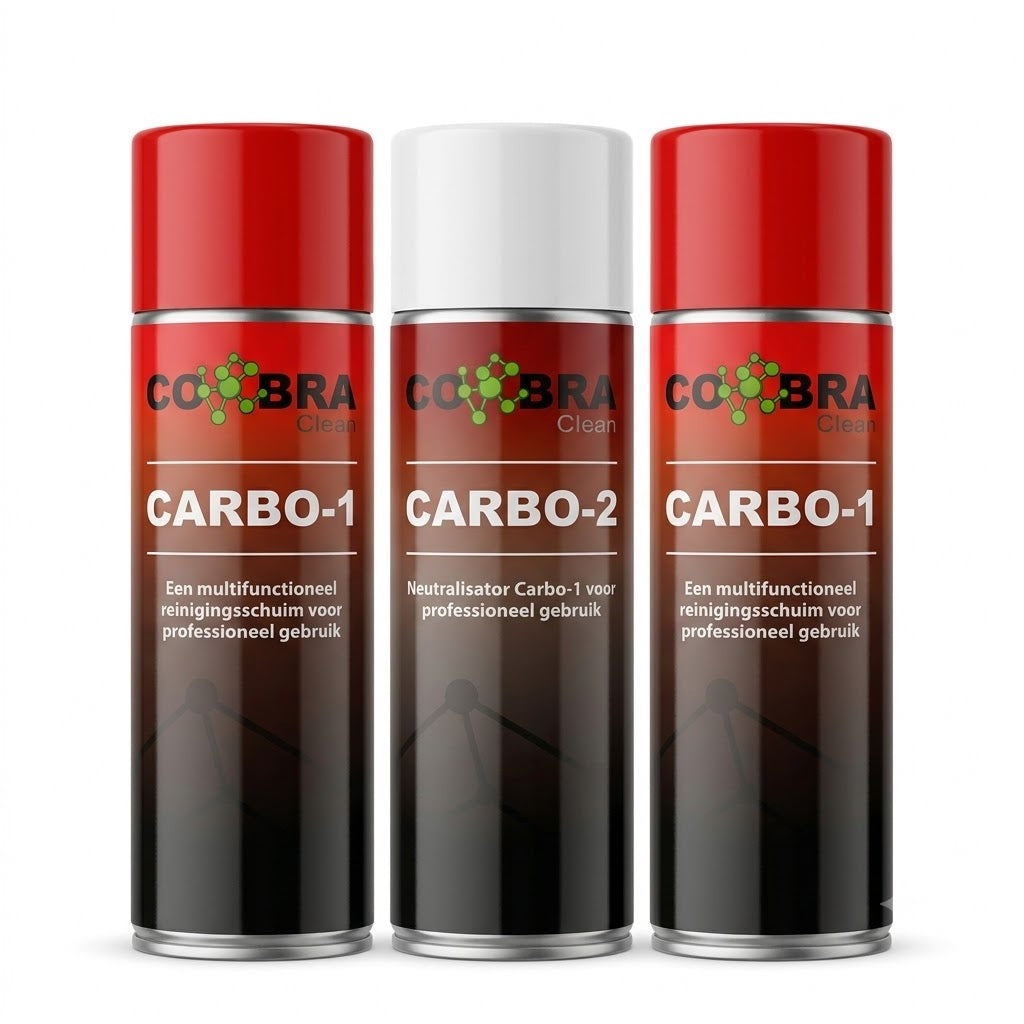
COBRA Carbon Clean Set
COBRA Carbon Clean Set
Couldn't load pickup availability
Description
CARBO CLEAN SET
CBS-455 CARBO-1 (500ML) 2x
CBS-456 CARBO-2 (500ML) 1X
TO BE USED FOR:
- Oil consumption due to stuck piston rings.
- Cleaning valves without disassembling the intake manifold.
- Cleaning the variable part of the turbocharger.
PRODUCT DESCRIPTION COBRA CARBO-1
Carbo-1 is a multifunctional cleaning foam. A specially developed foam with a powerful formulation that dissolves and removes all operationally caused contaminants in an engine's combustion chamber. Carbo-1 removes carbon deposits in the cylinder head area, especially on the valves, piston crown, and even down to the oil control ring. Cleans intake and exhaust valves. Residues in the EGR valve, the turbo, and the air intake system are also effectively removed. Carbo-1 does not affect seals. Due to its special formula, Carbo-1 remains an active foam. The foam expands sufficiently to creep into places that otherwise cannot be reached without complete disassembly.
PRODUCT DESCRIPTION COBRA CARBO-2
Carbo-2 causes a chemical reaction that liquefies the previously applied cleaning foam (Carbo-1) and binds the dissolved contaminants. With Carbo-2, the resulting emulsion and dissolved deposits can be safely removed from the combustion chamber. Because Carbo-2 has a very efficient lubricant with exceptionally high cohesion (extreme pressure additives), Carbo-2 protects the engine against high friction during the start-up process. This prevents wear of mechanical components. In addition, seals are effectively protected.
OIL CONSUMPTION DUE TO STUCK PISTON RINGS
This step-by-step guide removes contamination from and behind the piston rings without disassembly. This restores compression and brings oil consumption back to an acceptable level. CBS-400-002
- Check with an endoscope if oil is visible on the cylinder wall. This indicates it is being carried past the piston rings.
- Are the intake valves also wet? This is often due to hardened valve seals. These will also be restored later in this treatment.
- Ensure that all valves of cylinder 1 are closed and the piston is approximately 4 cm before TDC. You can quickly see this by working with an endoscope.
- Using the supplied hose, inject Cobra Carbo-1 through the spark plug hole, filling the compression chamber with foam.
- If foam comes out of the spark plug hole, hand-tighten the spark plug. Carefully rotate the crankshaft until the next cylinder is in the desired position.
- Repeat this treatment for each cylinder. Usually, this is in the order 1-3-4-2. Allow the foam to act for a minimum of 12 and a maximum of 24 hours.
- Remove the spark plugs and generously spray Carbo-2 into the cylinder area with the hose. This is done to create a lubricating film and neutralize the foam.
- Allow to act for 15 minutes.
- Suck all fluid out of the cylinder area.
- Crank the engine without spark plugs.
- Install the spark plugs and take a vigorous test drive. Ensure the engine reaches operating temperature.
- Add Mécatech NCH engine flush to the old engine oil.
- Drive 300 to 500 km with the car, preferably spread over a few days due to the hot-cold operation.
- Drain the oil with the engine warm and install a new oil filter. Add Mécatech AFM to the new oil. This will need approximately 500-1000 km to achieve the final result.
CLEANING VALVES WITHOUT DISASSEMBLING THE INTAKE MANIFOLD
This step-by-step guide cleans the intake valves of a gasoline engine without disassembling the intake manifold CBS-400-001
- Check the degree of contamination on the intake valves with an endoscope. If intake valve contamination is found, follow the procedure below.
- Start the car and let the engine run for about 5 minutes to generate some temperature.
- Remove the spark plugs and ensure that the intake valves of cylinder 1 are open.
- Using the supplied hose, inject Cobra Carbo-1 through the spark plug hole, filling the compression chamber with foam.
- If foam comes out of the spark plug hole, temporarily close the hole with a rag and spray for another 5 to 6 seconds so that the foam can reach above the intake valves.
- Keep the hole closed for about 30 seconds so that the foam can adhere.
- Repeat this treatment for each cylinder.
- Allow the foam to act for at least 2 hours for maintenance use.
- For corrective use, leave for 12-24 hours.
- Generously spray Cobra Carbo-2 into the cylinder area with the hose. This is done to create a lubricating film and neutralize the foam.
- Allow to react with each other for approximately 15 minutes.
- Suck all fluid out of the cylinder area.
- Crank the engine without spark plugs to remove any remaining residue.
- Install the spark plugs and take a test drive with varying RPMs, ensuring the engine reaches operating temperature.
- Check the result with an endoscope.
- In case of very extreme contamination, repeat the treatment.
CLEANING THE VARIABLE PART OF THE TURBOCHARGER
This step-by-step guide cleans the variable part of the turbocharger if it is stuck due to soot CBS-200-005
- Read out the fault codes and check if there are any faults related to the variable geometry (VGT).
- Try to move the VGT section through its full range using the actuator test/or vacuum pump.
- If this is not possible, follow these steps.
- Disassemble the exhaust from the turbocharger.
- Using the supplied hose, completely fill the turbocharger with foam through the exhaust port using Carbo-1.
- When foam comes out, close the hole with a cloth and spray for a few more seconds. This forces the foam to the variable part at the back of the turbocharger.
- Allow the foam to act for 30 minutes.
- Spray the turbocharger full of foam again and carefully try to move the variable part. Do this until movement from stop to stop is possible.
- Start the engine without the exhaust, with a cloth over the turbo exhaust, to remove any dislodged contamination.
- Reassemble the exhaust and add 1 dose of Mécatech DPF, EGR, Turbo cleaner to the tank.
- Clear the fault codes and take an extensive test drive with many variable RPMs.
Deel